
Everyone around me seems to have watched Succession. Advisors, colleagues and clients speak about it as if it were required viewing for anyone working with family enterprises.
I tried to watch the award-winning HBO series on numerous occasions, stopping repeatedly, not because it wasn’t brilliant, but because it was brutal. The cynicism, humiliation, and constant power games felt too extreme. For anyone working closely with multi-generational family enterprises, this world of perpetual chaos and zero-sum power felt not only far removed from our reality, but was also a painful mirror reflecting everything that causes a family enterprise to fail.
Thankfully, the reality we see at LGA working with client families is very different. In my experience, most families committed to multi-generational success are driven by purpose, values, and responsibility, not cruelty or manipulation. Of course, they face complexity and conflict, as all families do. However, more often than not, they approach it from a place of care, long-term vision, and a deep commitment to something larger than themselves.
Beyond the Drama: LGA’s Seven Drivers of Continuity
Watching the series through a professional lens, I knew that the essential forces that sustain family enterprises across generations were missing in the Roy Family system.
At LGA, where our team has extensive experience working with clients across the globe, we frame these forces as the Seven Drivers of Continuity: the foundational elements of governance that allow families to design an exciting and feasible path to the future and to ultimately safeguard their shared legacy.
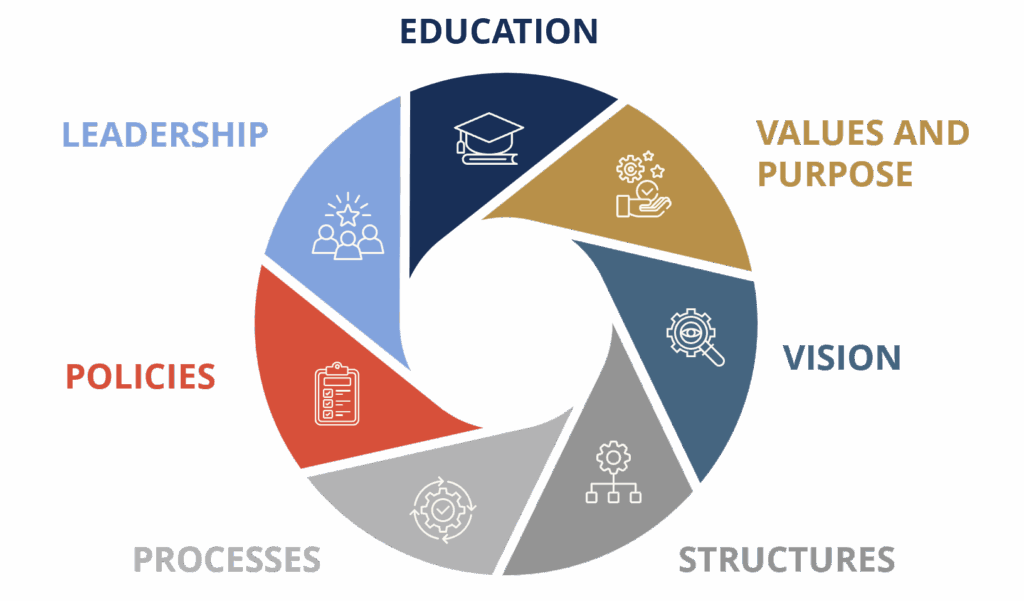
The dysfunction and extreme drama audiences observed when watching Succession are a direct result of the Roy family ignoring these critical drivers. While the perpetual conflict, fear-driven decision-making, and zero-sum battles for control are what makes their fictional drama so compelling, in advisory terms this is a textbook example of systemic failure.
In many ways, Succession offers a masterclass not in how to run a family enterprise, but in the rapid, inter-generational erosion that occurs when a family lacks these seven essential foundational pieces required to ensure successful and sustained continuity – not only for the business, but also for ownership and the family. Every humiliating interaction and failed negotiation can be traced directly back to the absence of these crucial continuity mechanisms.

The Seven Missing Drivers from Waystar RoyCo
The true brilliance of Succession is that it provides a perfect, albeit painful, negative case study. To understand the Seven Drivers of Continuity that sustain generational success, we can examine the specific mechanisms the Waystar RoyCo system lacked.
1. Education
The Roy family displays no desire for development, nor curiosity to better understand how to build collectively and sustainably for the future. This lack of commitment to continuing education can be seen as the primary driver of their dysfunction.
This is a fundamental failure in the face of Education – the first Driver of Continuity. Families that invest in learning together through programs, mentorship, and lived experience ultimately create continuity that is earned, not inherited.
2. Values
Without a clear ethical code, decisions at Waystar become purely transactional, resulting in the moral and operational freefall so characteristic of Waystar RoyCo.
This is a classic symptom of a lack of shared Values. A family enterprise is defined by its shared Values, which make it more than simply a collection of individual shareholders but rather a community with a common purpose. These values instill moral gravity in decisions, making success a matter of stewardship and contribution, rather than solely sustaining control.
3. Vision
The Roys were unified only by their desire for the patriarch Logan’s approval and control over the status quo. For example, when they briefly united against a potential hostile takeover, it was not out of shared respect for the company’s integrity, but solely because losing control would threaten their guaranteed status.
This is a failure to establish a unified Vision. Such a Vision connects generations around the future, not the past. It turns succession from a threat into a project of hope and engagement – something larger that everyone wants to be part of.
4. Structures
The Roy family operates with loyalty and fear, destroying both governance and relationships in the process. The entire Roy hierarchy is structured so that loyalty is merely a performance to avoid the patriarch’s fear-inducing wrath, allowing Logan to pit his children against one another and consistently dismantle both personal bonds and ethical corporate governance to maintain his sole authority.
All this stems from the absence of Structure. Structures such as family councils and independent boards, are designed to bring clarity, not control. When this governance architecture is well-built, it protects the family’s emotional bonds by separating love from decision-making.
5. Processes
The Roy family’s decision-making style is ad hoc, opaque, and manipulative, virtually guaranteeing systematic distrust. The most dramatic example of this is the absence of a CEO succession process approved by the independent members of the Board of Directors, resulting in the role being an opaque birthright or a sudden announcement based solely on Logan’s unpredictable whim.
In contrast to this chaos stands Process. With clear and transparent Processes for leadership transitions, appointments, and performance evaluations, decision-making becomes more intentional, predictable, and fair.
6. Policies
In the absence of established Policies, key decisions, such as Logan’s youngest child Shiv assuming a key leadership role, or Roman receiving a promotion, become subjective and emotional negotiations. This lack of structure ultimately causes more damage to the continuity of the Roy family enterprise than any solution.
Policies are essential for translating values into transparent and replicable practices. Clear guidelines for entry, compensation, conflict resolution, and dividends – minimize uncertainty and prevent individual motives from undermining the collective interest.
7. Leadership
Ultimately, at Waystar, Leadership was a weapon used to maintain dominance, rather than a responsible action aimed at securing its future. Consider how Logan publicly promises the CEO role to one of his children only to abruptly withdraw the offer or change the terms shortly thereafter, purely to keep them off-balance.
Effective Leadership is about multi-generational stewardship, not the accumulation of power. It means creating the conditions for others to grow and perform, modeling shared purpose, and having the courage to let go when the time comes. It is not a position for one person, but a collective responsibility and a long-term family investment.
A Mirror of Absence
Though it took me over three years to finally watch the whole series, I now realize that Succession is more than just a cautionary tale. It is a high-stakes drama illuminating the choice every family enterprise must make. The implosion of Waystar RoyCo was not the result of a single flaw, but a systemic failure born of neglecting the Seven Drivers of Continuity. The Roys, locked in a zero-sum battle for control, proved that immense wealth and power are no defense against the corrosion of unchecked ego and a vacuum of shared purpose.
The true lesson is not in the drama, but in the deliberate, often unglamorous work required to avoid it. Enduring success isn’t inherited; it is built with intention. Lasting family enterprises understand that their ultimate product is not their business, but their family’s capacity to build a future together. They replace the Roys’ fear-driven loyalty with values-led stewardship and a unifying vision. It is earned through the humility to embrace education over entitlement, the courage to establish structures that separate love from decision-making, and the discipline to codify policies and processes that ensure fairness and transparency.
So after watching a show like Succession, the real question for your family is not, “How do we avoid WayCo’s fate?” but rather, “What can we do proactively and collectively today to build an enduring enterprise?”