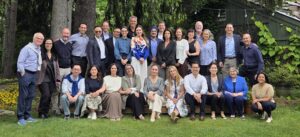


As your leadership teams regroup for the final stretch of the year, and the complexities of governance and family dynamics are coming into sharper focus, we will explore what marital research reveals about boardroom partnerships, why a Single Family Office demands more than a spreadsheet, and how conceptual models help navigate multi-generational complexity.
We begin with the latest article by our Partner Mika Mazor, who draws on Dr. John Gottman’s landmark marital research to show how the “Four Horsemen” of relationship collapse appear at the executive table.
Then our Partner Neus Feliu will unpack why a family office needs governance as much as any operating company, and frame three fundamental questions: When does a family actually need an SFO? What should owners ask before building one? And why does governance matter as much here as in any operating company?
Finally, we’ll share one of the highlights from Season 2 of the LGA Lighthouse Podcast. In this episode, host Tim Yeung kicks off a two-part conversation with LGA co-founders Iván Lansberg and Kelin Gersick. Together they explore the practical power of conceptual models for helping families make sense of the complexity inherent in multi-generational businesses.
We are grateful to our clients and partners who allow us to play such a pivotal role in supporting family enterprises worldwide. As we approach the end of the year, we wish you continued success and prosperity in the months ahead.
Your LGA Global Team
The Four Horsemen of the Apocalypse
What Divorce Research Teaches Us About the CEO-Chairman Partnership
By Mika Mazor
In 1986, at the University of Washington, Dr. John Gottman and his colleague Professor Robert Levenson built a laboratory that looked like an ordinary apartment, the one the press came to call the “Love Lab.” They invited couples to sit down and discuss contentious topics, sometimes for just a few minutes. They didn’t ask whether the couples were happy, nor did they hand out questionnaires. They simply observed how partners spoke to each other: who interrupted whom, who rolled their eyes, who engaged and who withdrew.
In a landmark study published by Sybil Carrère and Gottman in 1999, 124 newlywed couples were examined, and they discovered they could predict which couples would divorce within six years based on just the first three minutes of a single conflict conversation. The prediction wasn’t derived from the content of the argument, but from its form.
Now swap the couch for a boardroom table, drop the words husband and wife, and replace them with Chairman and CEO.
Gottman himself never studied corporate boards, but the question his research raises translates easily: What if the best way to predict the future of an executive partnership isn’t to examine business performance alone, but to listen to a few minutes of small talk between the Chairman and CEO in the corridor, moments before they walk into the boardroom?…
A Platform, Not a Portfolio
Why a Family Office Needs Governance as Much as Any Operating Company
By Neus Feliu
The wire cleared on a Tuesday. After eighteen months of due diligence, a third-generation family had just sold a controlling stake in the industrial business their grandfather founded. A nine-figure sum landed in an account that, until that morning, had been managed by the same finance director who ran the company’s payroll. By Friday, the questions had started: Who decides how this is invested? Who speaks for the family? And what, exactly, are we now – owners of a company, or a company of owners?
This scenario plays out in boardrooms and family meetings worldwide. In fact, over 8,000 single family offices (SFOs) now operate globally – a number projected to grow to 10,720 by 2030, overseeing USD 3.1 trillion in assets. Yet, as this family discovered, the first step isn’t spreadsheets or asset allocation. It’s governance.
That experience repeats itself, in different currencies and across generations, in family after family. It is the exact moment the SFO is born: when a family’s wealth outgrows the operating company that created it and needs a dedicated platform of its own.
Yet the families who navigate this transition successfully rarely start with a spreadsheet. They start with three fundamental questions…
LGA Lighthouse: Season 2, Episode 11
The Power of Models – Navigating the Network of Families
In this episode of the LGA Lighthouse Podcast, host Tim Yeung kicks off a two-part conversation with family enterprise pioneers and LGA co-founders Iván Lansberg and Kelin Gersick. They explore the practical power of conceptual models—not as academic concepts, but as essential tools for helping families make sense of the deep complexity inherent in multi-generational businesses.
LGA Highlights: What We’re Reading, Watching, and Listening to This Month
In a rapidly shifting world, anticipating the future requires proactivity and perspective. That’s why our global team is on a journey of constant discovery and continuous learning in search of the latest ideas in business, leadership, family dynamics and beyond.
For this edition, we’ve curated the following resources that may be of interest—sparking new conversations across our team and expanding our thinking and work with client families:
- 📖 The Octopus Organization (Book) by Phil Le-Brun & Jana Werner: Drawing on executive leadership at Amazon, McDonald’s, and top global enterprises, this book offers a blueprint for overcoming organizational inertia and cultivating continuous adaptability. The authors identify thirty-six operational “antipatterns” that stall progress, and offer actionable “levers” to drive meaningful change in months rather than years. For families balancing legacy with innovation, it provides a fresh and pragmatic way to move beyond rigid governance structures and embrace a more dynamic, agile, and resilient enterprise design.
- 🎙️ 10% Happier with Dan Harris (Podcast): In this episode, host Dan Harris interviews author Kate Murphy (You’re Not Listening) on the science of non-verbal communication, emotional attunement, and interpersonal alignment. Murphy breaks down how our baseline “affective presence” sets the tone in high-stakes environments, and explores how to read a room without absorbing others’ stress. In family businesses, where unspoken family dynamics and emotional spillover can derail governance and strategic discussions, this episode offers tools to foster psychological safety, maintain personal boundaries, and build authentic alignment.
- 📺 Ford v Ferrari (Film): This fast-paced historical drama tells the story of how an agile team of engineers and drivers set out to build a revolutionary race car to challenge Ferrari’s dominance at the 1966 24 Hours of Le Mans. Beyond the racetrack, the film offers a fascinating study in corporate vs. entrepreneurial dynamics. It highlights the friction that occurs when visionary, hands-on operators collide with a rigid multi-generational corporate hierarchy, and the challenges for families when balancing innovation and change.
We hope you find these resources as inspiring and thought-provoking as we have. Please feel free to send us your favorites as well, as we are always on the lookout to gather and share great ideas!
Meet Our Newest Advisors
In our ongoing efforts to broaden our global impact and better meet the needs of our clients, we recently welcomed two new advisors to our growing global team, both of whom bring a wealth of expertise and experience to their work with enterprising families.

Mariana Martínez
United States
Mariana Martínez PsyD integrates psychological science, Bowen Family Systems Theory, and family enterprise dynamics into her work with enterprising families. Drawing on more than 25 years of experience, the uniqueness of Mariana’s approach lies in her ability to bring a nuanced understanding of the human dynamics that influence decision-making, leadership, governance, ownership, and continuity across generations.
She is known for creating thoughtful conversations that enable families to address delicate issues with greater objectivity, uncover new possibilities, and make decisions aligned with both family values and the long-term success of the enterprise.
Fully bilingual and bicultural, Mariana advises families in both English and Spanish. She resides in Washington, DC, with her husband. Together, they enjoy spending quality time with their three adult children.

Leo Gesualdo
Canada
Leo Gesualdo's work over more than three decades spans senior family business and family office leadership roles as well as public practice. With a passionate, thoughtful approach to the challenges enterprising families face, he specializes in governance design, family office strategy, continuity planning, strategic alignment, and risk management, pairing deep financial and investment expertise with the strategic fluency needed to protect and grow every form of a family’s capital—human, financial and structural—across generations.
A Family Enterprise Advisor (FEA) and a Chartered Professional Accountant (CPA, CA), Leo is drawn to helping owners with divergent interests align on the hard decisions that succession and ownership transitions demand. He excels at turning a family’s philanthropic and generational goals into actionable investment and capital policy, and building the strong governance systems required for effective stewardship.
Leo lives in Toronto with his wife, three children, and their Portuguese Water Dog.
We appreciate you taking the time to engage with our latest insights.
If you know someone who might enjoy this content, please feel free to share or encourage them to subscribe!