

In many business families, there is little real discussion about whether a young family member should work in the company and if doing so is good for them, the family, and the business. The answer often just happens on its own, based on how close a person is to the family business or whether there happens to be an open job at the time, without any clear guidelines or process to guide the decision.
This matters more than it might seem. Family employment is one of the most common sources of conflict in business families — it can become a real powder keg for family owners. When it goes badly, the costs are high, both for the business and for the family relationships that hold it together.
Many families frequently look for a “rehearsal before the show”, using short-term internships as a way to explore this topic. Internships give young family members and the company a chance to get to know each other without a long-term commitment. This is useful practice even in families where family members do not want a career in the company, because these programs help bring the family closer to the business.
Consider 16-year-old Camila. A high school junior, she spends two weeks of her school break working in different parts of her grandfather’s company: filing documents, packaging products, and helping out at a welcome event for new employees. The point of this experience is not for Camila to decide if she will work in the business one day, but for her to gain appreciation for the family legacy and exposure to the working world.
Now think about Oscar, who is 22 years old and about to finish college. He spends six months working in the product development area of his family’s manufacturing business. Unlike Camila, Oscar is evaluating — and being evaluated — to see if this is a place where he wants to build his career and if he is a good fit.
Finally, think about Isabel. At 32, she has worked for nearly a decade in a global consumer goods company and has a thriving career. For a few months, she rotates through the purchasing, logistics, and store areas of her family’s retail business. Unlike Oscar, Isabel is not thinking about working in the company day to day; she is getting ready to take her father’s seat on the board.
These three examples exhibit the myriad ways that internships can be used to support different development objectives. They can be an important tool to strengthen family enterprises, but their design must be aligned with their goals. All internships — and family interns — should not be treated the same way.
A Range of Options, Not One Fixed Formula
It helps to keep in mind why this matters in the first place. Family members who work well in the business are great news for the business and for the family — but that only happens when the family puts real effort into designing programs that support them and manage the risks that come with family employment. Preparing people to work in the company is only one of several goals that business families have. You also need owners who understand and feel connected to the business, even if they never work there. And as a family, you want the next generation to grow up with the values that matter most to you — for many families, that means a strong work ethic and a clear sense of their own interests and strengths. Internships, done well, can support all of these goals at once.
There are different internship designs that address different family, business, and ownership goals. In our experience, these programs generally fit into the five general types listed below.
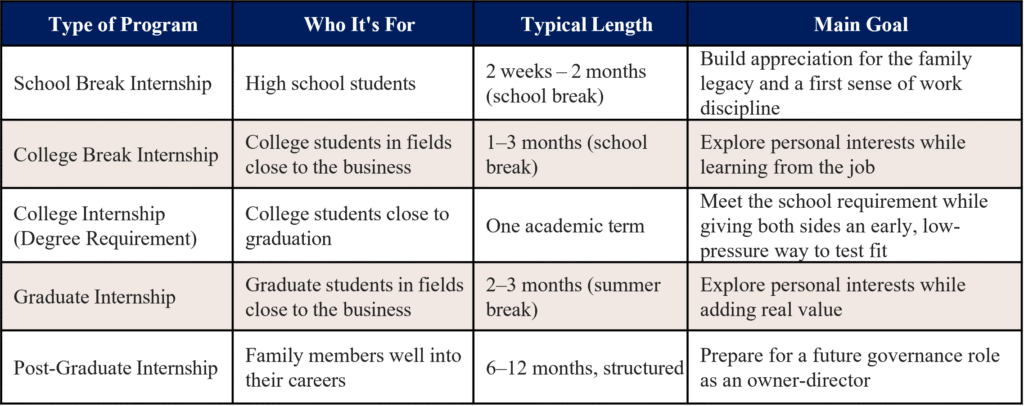
A school break internship is usually a young teenager’s first real look at the business. It can run anywhere from two weeks to two months during a school break, with simple, safe tasks like filing paperwork, packaging products, or helping out at a company event. The goal isn’t for the teenager to decide whether they want to work in the business one day — it’s to build early appreciation for the family legacy and give them a first taste of what work is like.
A college break internship gives university students in fields close to the business a chance to explore their own interests over a school break, learning directly from the work itself. These programs usually run one to three months, with tasks that help the student build foundational skills and get a real feel for different parts of the business, even while they are still early in their studies.
A college internship (degree-requirement) occurs when a student needs to complete a work placement to graduate, which is common in universities throughout Latin America. For business families, this is a natural opportunity: it meets the school’s requirement while also giving both sides an early, low-pressure way to test whether there’s a good fit. Family employment matters a great deal to business families — done well, it can strengthen both the business and the family’s connection to it for generations to come. This type of internship is often the first real test of whether that fit exists.
A graduate internship is a step up from a college break internship. It’s for students in graduate programs — often an MBA or another master’s degree — in fields close to the business. These internships usually run two to three months over a summer break, and because the intern already brings more academic and professional experience, the work tends to be more substantive: exploring personal interests while adding real value to the company, often through a specific project or assignment.
A post-graduate internship is the rarest of the five. It is usually for family members who are already well into their own careers, but who want a real immersion in the family business — not because they plan to work there day to day, but because they are preparing to become governing owners. In some family enterprises, the governance system is complex enough that being a governing owner is itself close to a full-time role: serving on boards and committees and staying closely informed about the business. This kind of internship, often six to twelve months and highly structured, is designed to prepare someone for exactly that.
Benefits of Offering Family Internship Programs
When internship programs are well planned, they bring benefits in multiple ways.
An internship can be a meaningful first contact with the company for any family member — but this is especially true for those who did not grow up close to the business, whether due to living in another city, an age gap between generations, or their parents’ choices. For them most of all, that early exposure often turns into real affection for the family legacy and deep respect for the people who run the business every day.
Internships also provide an opportunity for young family members to develop work discipline. This is particularly true for school and college-aged interns, for whom finding meaningful employment experiences (due to age and time limitations) can be difficult. Internships also help young family members identify their own interests by exposing them to different roles and industries.
For those who are moving toward a role as an owner or a board member, the experience gives them a first-hand look at how the business runs and what its culture is like. No financial report can replace that. Walking into the boardroom with this kind of experience changes the quality of the questions they ask and how well they understand the business discussions.
For the company, internships provide a chance to see the talent, work ethic, and lived values of a family member up close, in a low-risk setting, before making a long-term hiring decision. And no matter how it turns out, the family member walks away with new skills and another line on their resume — useful for finding work inside or outside the family business.
Identified Risks of “Rehearsals”
These same programs can also cause friction if they are not handled with care.
On the company side, non-family managers may feel that supervising a family intern is an awkward job, almost like babysitting. How good the experience turns out to be depends a lot on how willing that manager really is. A common risk is that internships take too much time from the people who supervise the intern — time that is often not planned for, considered as part of their job duties, or counted as part of their own career goals. Managing a family intern is real work, often far beyond the benefit of the intern’s contribution, but too often this additional responsibility is overlooked.
There is also the risk of false expectations: the family member, or their parents, may see the invitation as an implicit promise of a future job. If the company later decides not to continue the relationship, this can lead to feelings of disappointment and even disinterest in the family business.
Internships also pose many of the same risks as other forms of family employment. Because of their familial connection to the enterprise, a family intern may — without meaning to — skip the normal chain of command, offer opinions on decisions that are not theirs to make, or receive a level of respect from other staff that they have not yet earned. This can make things uncomfortable, especially for long-time employees who are not part of the family.
Moreover, if the process by which the family intern is chosen or evaluated differs from other interns, then the rest of the company may perceive this as favoritism. This can hurt the core principle that people should be judged by merit rather than their last name.
People in the company will often see them mainly as “the owner’s son” or “the owner’s niece.” This may shield them from the real pressures of work life: tight deadlines, strong personalities, real challenges and office politics. If the job environment is too soft on the family intern — easier tasks, more flexible hours, gentler feedback — it can give both the family and the company a false picture of how the family intern is actually performing. This can lead to flawed decisions regarding the individual’s true competences and job fit later on, in either direction.
There is also the risk of overconfidence: the family intern, or their parents, may think that finishing one internship is enough to be ready for a management or governance role. An internship is only a small window into the business. It needs to be followed by real training, preparation, additional education and broader experience before and after taking that step.
There is also the risk of reputational harm inside the company. If a family intern performs poorly, behaves unprofessionally, or mishandles real responsibility, that impression rarely stays contained to the family intern alone — it can shape how employees view the wider family, and even raise doubts about the judgment of whoever sponsored them. Because family interns tend to be more visible than other interns, their mistakes are often noticed, remembered, and talked about for longer. This makes it even more important to set real expectations from the start and give honest feedback throughout the internship, rather than letting problems go unaddressed until it is too late.
Finally, without meaning any harm, family members who lead the business sometimes use the family intern as an informal source of information — to hear what people are saying around the office or to learn about problems that are usually not talked about openly. This can put family interns in an awkward position, and the risk of being seen as the “family informant” limits their ability to integrate into the company ‘as just another member of the team’. Family leaders should be aware of this and recognize what is — and is not — fair to ask from an intern.
All of these risks need to be actively mitigated by those designing and managing family internships.
How to Handle Compensation
One of the most common questions when building these programs is whether family interns should be paid. There is no single right answer, but there is a pattern: pay tends to be small or non-existent for school-break and college-break programs, and gets closer to market rate as the program becomes longer, more structured, and the intern takes on real responsibilities — as is often the case in graduate and post-graduate internships.
In my experience it is appropriate to offer some form of pay, however modest, even for the youngest interns and the shortest work programs. Compensating the family intern gives the company greater standing to expect real accountability. It also prevents the family intern from thinking, consciously or not, that “since I’m not getting paid, I don’t have to take this seriously.” Not compensating, especially in longer or more structured programs, can send the opposite message of what you intend.
At the same time, it is worth considering the risks of getting pay wrong. If pay is higher than market rate, it may look like special treatment compared to other interns or staff. If pay is too low, it can feel like the company does not value the family intern’s effort or contribution. Whenever possible, pay should match the level of responsibility and time commitment, follow the company’s general pay policy and comply with local labor laws for minors or students.
Good Practices for Making Family Internships Work
- Build the program before you need it. The options you offer should match the goals of the business and the family, and fit what the company can realistically support. If you wait to design the program once a candidate is asking for it, you risk shaping the entire structure around that single individual instead of maintaining a clear, consistent standard.
- Set the purpose before the format. The type of program you offer each family member should serve a clear goal — building love for the business, exploring interests, testing the fit, or preparing for governance — rather than simply repeating what worked in the past.
- Assign a non-family sponsor inside the company. The internship sponsor can be the direct manager, or an experienced HR executive. What matters most is that this person understands the family dynamics well and is trusted by the family. They should be able to monitor progress and give honest feedback without the emotional weight of judging a relative.
- Pair them with a mentor. This can be a family member or an outside professional. Their role is to help the family member make sense of the experience and, where appropriate, build their resume for the broader job market. In smaller companies, this person can also be the non-family sponsor; however, where possible, it is better to keep the two roles separate.
- Give the program real structure. Set clear tasks, a timeline, and a way to measure results from day one, instead of making it up as you go. If structured internship programs already exist in the enterprise, determine early on whether family members are eligible to participate in these programs (after assessing the pros and cons of doing so), or whether they should have a separate, custom-designed track.
- Share the program’s rules with the right stakeholders. It is important that senior leaders and those who are working with the family intern understand the purpose of the program, selection criteria and evaluation process. This transparency helps avoid the impression of favoritism. In large or complex companies — and even in many mid-size ones — sharing rules company-wide may not be practical or even necessary. What matters is that the team members close to the intern, or in a position to observe and provide feedback on their work, know the rules.
- Be clear about what the internship is not. Before the program begins, align expectations with the family member about what to expect. Make sure they understand that joining the program is not a promise of future employment, and is not, by itself, sufficient preparation for a governance role.
- Apply standards of discipline and accountability consistently. Regardless of the program’s goals, the format, or the intern’s age, the same standard rules regarding hours, dress code, and time-off requests should apply. For example, the family intern must follow standard procedures to request a day off for a family trip rather than simply failing to show up. If the family intern does not do this, the family intern’s chance to experience real responsibility is forfeited. Failing to enforce these standards deprives the intern of genuine professional accountability and risks damaging the family’s reputation within the company.
- Don’t let the process become a burden for HR. Give it the same structure and priority as any talent management program, instead of treating it as an informal favor. Establish clear limits on participant capacity and avoid excessive customization.
- Periodically review and refine the program. What proved effective for one generation may not work for the next. Regularly evaluate outcomes and adjust the design to ensure family internships remain valuable over time.
Conclusion
These practices do not remove the inherent tension between opening the door and protecting the business. However, when the purpose is clearly defined, when the right people are supervising the program, and the family understands that an internship is an opportunity rather than a guarantee, these programs become one of the most effective “rehearsal” tools available. They provide both the family and the company with the clarity needed to make informed, objective decisions when the time comes.