

Introducing independent directors into a family enterprise is often perceived as a significant milestone in the evolution of governance. It signals openness, professionalization, and a willingness to incorporate external perspectives into decision-making.
Consider a board meeting of a third-generation family enterprise. The room is filled with talented family members who have spent their lives building the business and family legacy. The atmosphere is warm, the history is deep, but the conversation is circling.
Beneath the surface lie pressures from a shifting market and differing views about a major acquisition. Certain questions remain only lightly touched, not because they lack importance, but because they intersect with decisions made in the past, with traditions that have served the enterprise well, and with a natural respect for the leadership that shaped its path.
At moments such as this, the presence of independent directors can be a powerful intervention. While often described as a “professional milestone,” a box to be checked on a governance journey, independent directors are far more than technical experts. At their best, they help create a space of thoughtful distance, where ideas can be examined without eroding respect, and where inquiry is seen not as disloyalty, but as stewardship.
Over two decades of working with complex, multi-generational family enterprises, I have learned that presence is not the same as impact. True independence is defined less by who sits at the table and more by whether that table itself invites inquiry, diverse perspective, and disciplined reflection. The critical question, therefore, is not whether independent directors are present, but whether the surrounding governance system enables them to generate meaningful impact alongside family directors.
For independent directors to truly add value, they must operate within a functional and coherent governance system. This requires attention not only to board composition, but to how the board works, how governance bodies across the enterprise interact, and how governance connects with ownership, family dynamics, and the shared vision that binds them over time.
Beyond Presence: Where Value Is Truly Created
This shift from “being present” to “having impact” marks a turning point in a family enterprise’s governance journey. It is the moment where the focus moves from who sits at the table to how the table actually functions.
To bridge this gap, enterprising families must look beyond the formal act of appointing directors and focus instead on the conditions that allow them to contribute meaningfully at the table. In practice, this requires strengthening four interrelated pillars that sustain high-level governance: board effectiveness, role clarity, disciplined decision-making, and alignment across the system. Together, these pillars transform independence from a formal attribute into a practical source of value.
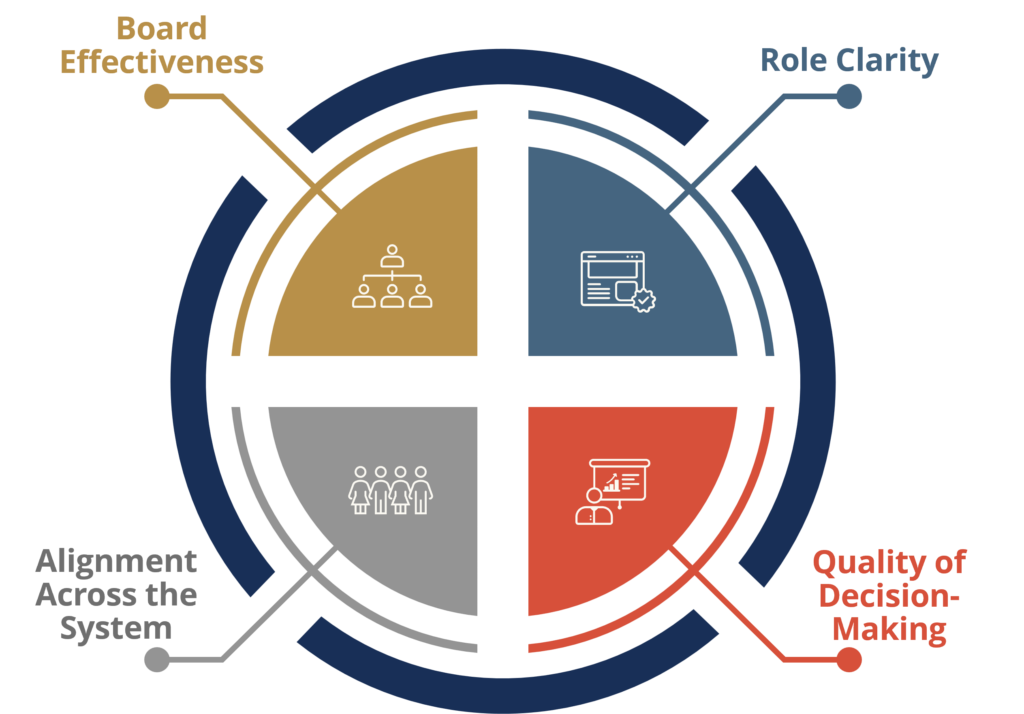
1.- Board Effectiveness: From Structure to Performance
Effective boards are not defined by their composition alone, but by how they operate. In leading family enterprise groups, boards are characterized by:
- Active Contribution: Directors who challenge constructively, shape strategic direction, and lead key discussions on strategy, CEO evaluation, and risk.
- Professional Architecture: Well-defined committees (Audit & Risk, Nomination & Governance, Compensation) with clear mandates and independent leadership.
- Intentional Design: Composition based on a skills matrix aligned with strategic priorities and structured renewal mechanisms.
A critical factor in board effectiveness is the leadership of the Chair, whose role extends beyond facilitation to stewardship of the board’s collective performance. The Chair shapes the quality of dialogue, ensures balanced participation, and fosters an environment of trust where constructive challenge is encouraged. This leadership aligns the board around shared priorities, enabling it to operate as a cohesive and high-performing team.
While the Chair plays a central role in navigating board dynamics, sustained effectiveness depends also on cultivating a culture of continuous learning and improvement. Leading families view governance not as a static structure, but as an evolving capability that requires periodic reflection and renewal. This mindset is most effectively anchored through regular internal and external board evaluations, a powerful, yet still not widespread, lever for governance maturity.
2.- Role Clarity: Defining the Governance System
In complex family enterprise groups, clarity of roles across governance layers is essential. A disciplined distinction must exist between ownership (the family as shareholders), the board (governance and strategy), and management (execution). Without this clarity, even highly capable individuals (family members, executives, or independent directors) will struggle to contribute their full value.
To illustrate, consider a family enterprise that recruited high-calibre independent directors and moved meetings to a formal boardroom. On paper the model appeared sound. In practice, however, the directors felt like “professional shadows” because the real decisions regarding strategy and leadership oversight still occurred in informal “pre-meetings” between siblings.
The system only shifted when the family moved from informal habits to institutionalized practices. In practice, this meant ensuring that the real conversation happened at the board table, supported by robust reporting and disciplined agendas. It meant establishing objective criteria for family members seeking to serve as directors, avoiding the automatic overlap between birthrights and board seats. Most critically, it meant entrusting independent directors to lead high-stakes governance processes, such as CEO evaluation and succession, where professional distance strengthens objectivity and credibility. Importantly, this separation does not create silos. Rather, it enables each governance layer to operate with clarity and discipline, while remaining aligned with the overall system.
3.- Quality of Decision-Making: Enabling Independent Impact
The true test of governance lies in the quality of decisions. Ultimately, governance effectiveness is measured by the choices an enterprise makes- especially when facing uncertainty, complexity, or competing perspectives. Achieving this level of quality depends not only on structure, but on the ability of directors, both family and independent, to exercise independent judgment and contribute meaningfully to the decision-making process.
High-performing boards are distinguished not only by what they decide, but by how they think together. In these boards directors consistently:
- Challenge assumptions and bring objectivity to sensitive topics.
- Remain aware of cognitive biases and actively avoid groupthink.
- Continuously ask themselves: “What are we not seeing? What are we not questioning enough?”.
In this sense, governance maturity reflects a shift from independent presence to independent impact. Over time, this discipline strengthens the board’s capacity to make balanced, well-informed decisions and reinforces the value of diverse perspectives around the table. When directors consistently challenge, reflect, and refine their thinking together, decision-making becomes more resilient, transparent, and aligned with the enterprise’s long-term interests.
4.- Alignment Across the System: Connecting Family, Ownership, and Governance
Governance is not a set of isolated structures; it is a system that must function coherently. Perhaps the most overlooked dimension of governance effectiveness is the alignment across the broader system – the way different governance bodies connect, exchange information, and operate around shared priorities. In effective family enterprise groups:
- The Family Council, Board, and Shareholders/ Owners are clearly connected, with defined roles and complementary responsibilities.
- Information flows transparently across these bodies enabling informed dialogue and consistent decision-making.
- There is visible alignment around long-term vision, values, and capital allocation, ensuring that governance decisions support the enterprise’s enduring purpose.
A Necessary Mindset Shift
Underlying all these elements is a deeper shift in mindset. Many families begin their governance journey with a focus on control, protecting the business, preserving the legacy, and often introducing independent directors as a safeguard to reinforce that stability. Over time, however, the most successful families evolve toward a value creation mindset, focused on long-term continuity, strategic growth, and sustainable value across generations. With this shift, expectations of directors also evolve – from guardians of legacy to active stewards of its future.
This evolution transforms not only governance structures, but also the nature of conversations at the table – the level of strategic ambition, the openness to challenge and the role of the board and its directors.
In family enterprise groups, the presence of independent directors is an important step, but it becomes meaningful only when embedded within a broader governance system that enables them to contribute fully and create impact alongside family directors.
The key question, therefore, is not: “Do we have independent directors?”
But rather: “Are we leveraging governance and the directors who sit at the table as a strategic asset to support continuity, cohesion, and long-term value creation?”